How to Build a Procurement Approval Chain for Your Nigerian Organization (Without the Email Chaos)
Verbal approvals, WhatsApp voice notes, and email chains leave Nigerian organizations exposed during audits and budget reviews. Here is how to build a documented procurement approval chain that holds up to scrutiny.
The audit arrives and the finance director asks a simple question: who approved this purchase?
Nobody can answer.
The WhatsApp message that served as the sign-off is somewhere in a 4,000-message group chat. The email approval chain is buried across three inboxes, two of which belong to people who have since left the company. The paper form — if there was one — is in a filing cabinet nobody has opened in six months.
This is not a hypothetical. It is the most common procurement failure in Nigerian organizations, and it happens regardless of size. Schools, construction firms, real estate companies, manufacturing plants — any organization that runs its procurement through informal channels is one audit away from a very difficult conversation.
The solution is not more discipline in using the current process. The current process is the problem. What Nigerian organizations need is a documented procurement approval chain — one where every requisition, every quote, and every sign-off is recorded automatically, in sequence, with timestamps, before a single naira changes hands.
Why Procurement Approval Chains Break Down in Nigerian Organizations
Most Nigerian organizations have a procurement process. The problem is that the process exists in people's heads, not in a system.
The typical informal procurement flow goes like this: a staff member identifies a need, mentions it verbally or via WhatsApp to their manager, the manager says "go ahead," someone sends a message to the accounts officer, and eventually a payment is made. Somewhere in this chain, a quote may or may not have been collected, a HOD may or may not have been informed, and finance may or may not have had full visibility before the expenditure.
Four things consistently break this process:
No single point of submission. Procurement requests arrive through WhatsApp, email, verbal communication, and formal memos — often simultaneously. Nobody has a complete picture of what has been requested, approved, or rejected.
Approval chains that exist on paper only. The policy says purchases above ₦50,000 require HOD approval. In practice, line managers approve purchases informally and inform HODs afterward — or not at all. The policy exists; the enforcement mechanism does not.
Quote requirements bypassed under pressure. The three-quote requirement is standard policy in most Nigerian organizations. When something is needed urgently, the requirement is waived verbally, and the waiver is never documented.
Finance visibility that comes too late. Finance often sees procurement requests at the payment stage, not the approval stage. By the time a requisition reaches accounts, it has already been "approved" — informally — by someone who may not have had the authority to do so.
The result is an organization that believes it has procurement controls but actually has procurement assumptions.
What a Proper Procurement Approval Chain Looks Like
A functional procurement approval chain has four components that work together:
1. A Formal Requisition at the Starting Line
Every procurement request begins with a structured submission — what is being requested, why it is needed, estimated cost, and the department it belongs to. This is not a WhatsApp message. It is a form that creates a record from the first moment.
The requester submits through a portal. The submission is timestamped. It cannot be lost, edited retroactively, or denied later. The requester can track the status of their request at any point without following up with anyone.
2. Mandatory Quote Attachments Before Routing
Quotes are attached at submission, not collected after approval. If the organization policy requires three quotes above a certain threshold, the system enforces it — the request cannot be submitted without them.
This removes the most common workaround: the after-the-fact quote collected post-approval to satisfy a procedural requirement that was already bypassed.
3. Multi-Level Approval Routing With Real Accountability
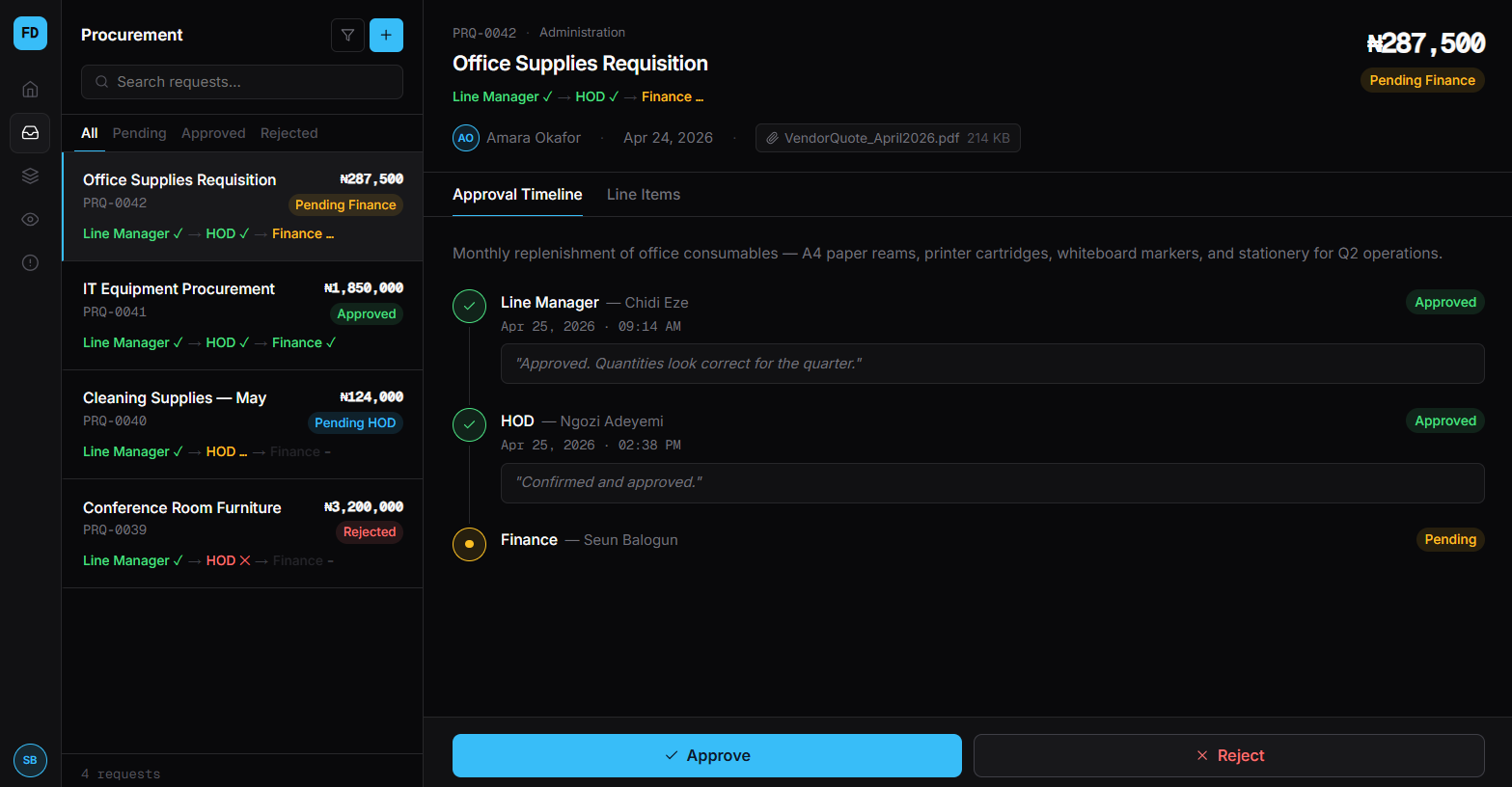
The approval chain routes automatically through the right people in the right order. A standard chain for a Nigerian organization looks like this:
- Staff submits the requisition
- Line Manager reviews and approves or rejects (with mandatory comments on rejection)
- HOD reviews the line-manager-approved request
- Finance sees the full chain — original request, all approvals, all attached quotes — before authorizing payment
Each approver receives a notification when it is their turn. Each approval or rejection is logged with the approver's name, role, and timestamp. If an approver has not acted within a defined period, the system escalates.
The critical difference from email: the approval cannot happen out of order. Finance cannot see the request until the line manager and HOD have acted. The chain is enforced, not assumed.
4. An Audit Trail That Cannot Be Disputed
Every action in the procurement process is recorded permanently: who submitted, who approved, who rejected, what comments were given, what quotes were attached, and at what exact time each step occurred.
When the auditors come — and in Nigerian organizations, they do come — the answer to "who approved this?" is not a conversation. It is a printout.
Who Needs Procurement Approval Software in Nigeria?
Schools and Boarding Schools
A boarding school with 500+ students makes procurement decisions daily: supplies, maintenance materials, equipment, food, services. The procurement chain in a school typically runs from a department head or matron through the bursar and principal. Without a documented system, what appears to be a properly approved purchase can turn out to be an informal verbal sign-off from whoever was available.
Rugby School Nigeria, an elite boarding school in Lagos, runs all procurement through a formal approval chain on FixDesk. Every requisition — from classroom supplies to facility maintenance materials — routes through the defined approval chain before finance authorizes any payment. The school's finance team can see every open requisition, every pending approval, and every completed procurement in real time.
Construction and Real Estate Firms
Procurement risk in construction is compounded by project timelines. When a site needs materials urgently, informal approvals happen — and informal approvals are exactly what creates audit exposure and budget overruns.
Ucalux Development, a Lagos-based construction and real estate firm, uses FixDesk's procurement module alongside project task tracking to manage operations. Every purchase request on a project goes through a documented chain, with quote attachments required before any approval is given, and finance visibility before any payment is authorized.
Nigerian SMEs and Mid-Sized Organizations
The assumption that procurement controls are only for large enterprises is one of the most expensive mistakes a Nigerian SME can make. Informal procurement in a 40-person organization creates the same audit exposure as in a 400-person one — the only difference is that the smaller organization has less capacity to absorb the consequences.
See how FixDesk supports Nigerian SMEs →
The Real Cost of Not Fixing Your Procurement Process
Beyond the audit risk, informal procurement chains have operational costs that accumulate quietly:
Budget overruns with no early warning. When procurement is spread across WhatsApp and email, nobody has a complete view of what has been approved to spend. Finance is reconciling after the fact rather than managing prospectively.
Duplicate purchases. Without a central record, two departments can independently purchase the same item — both with informal approvals — and nobody knows until the goods arrive.
Vendor relationship problems. Vendors who deal with Nigerian organizations through informal channels learn quickly that payment timelines are unpredictable. A documented approval chain creates predictable payment cycles, which improves vendor terms over time.
Fraud exposure. The most serious consequence of informal procurement is that it creates conditions for fraud. When approvals are verbal and undocumented, the gap between "what was approved" and "what was purchased" cannot be investigated effectively. A documented procurement approval workflow closes that gap entirely.
How to Move Your Procurement Process Off Email and WhatsApp
The transition to a documented procurement approval chain does not require a complete organizational overhaul. Organizations that do it successfully tend to follow a straightforward sequence:
Define your approval thresholds first. Before configuring any software, agree on what level of purchase requires what level of approval. A common starting structure for Nigerian organizations: below ₦50,000 requires line manager only; ₦50,000–500,000 requires line manager and HOD; above ₦500,000 requires the full chain including a finance director sign-off.
Establish your quote requirement by threshold. Which thresholds require one quote, two quotes, or three? Document this before you go live, not after.
Map your organizational roles. Identify which staff roles map to which approval levels — line manager, HOD, finance representative. In Nigerian organizations, the same person sometimes holds multiple roles; a good platform handles this without duplicating notifications.
Pilot with one department. Start with the department that has the most procurement volume or the highest audit risk. Run all procurement through the platform for two weeks before expanding organization-wide.
Make a clean cutover. The most common reason procurement platforms fail is that staff continue sending informal requests to managers who continue approving informally. A clean cut from a specific date — all procurement goes through the system from Monday — works better than a gradual transition that allows the old habits to persist.
Within four weeks of a clean cutover, most organizations have a complete record of every procurement request, every quote, and every approval chain. The informal process does not disappear immediately — but it loses its grip every week that the documented process works correctly.
Frequently Asked Questions
What is a procurement approval chain?
A procurement approval chain is a defined sequence of approvals that a purchase request must pass through before a payment can be authorized. In a typical Nigerian organization, this includes the requester's line manager, their department head, and a finance representative. A documented chain means each approval is formally recorded — not verbal or informal — with a timestamp and the approver's identity.
How many approval levels does a Nigerian organization typically need?
Most Nigerian organizations run well with three levels: line manager, HOD, and finance. Larger organizations or those with stricter compliance requirements sometimes add a fourth level — CEO or board sign-off for purchases above a defined threshold. Fewer than two levels creates compliance gaps; more than four creates friction that causes staff to route around the system informally.
Can I use email for procurement approvals?
Email creates a partial record — you have proof that a message was sent, but not that it was read, acted on in sequence, or accompanied by the correct documentation. Email chains get forwarded, replied to out of order, and lost when people leave the organization. Dedicated procurement approval software creates a complete, ordered, tamper-resistant record that email cannot replicate.
What is the difference between procurement approval software and a general project management tool?
General project management tools track tasks and milestones. Procurement approval software enforces a specific business process: submission with attachments, sequential role-based approvals, and a financial audit trail. The distinction matters at audit time — a task marked "complete" in a project management tool does not prove that three levels of authority reviewed and approved a purchase before payment.
Does FixDesk support multi-level procurement approval chains?
Yes. FixDesk's procurement module routes requisitions through configurable approval chains — line manager, HOD, and finance — with mandatory quote attachments, timestamped approvals, and a full audit trail. The chain is enforced automatically; finance cannot see or act on a request until the preceding approvers have completed their steps. See a live demo →
FixDesk is an internal operations platform for African organizations. The procurement module is one of five — alongside IT helpdesk, facilities management, leave management, and task management — in a single platform. See a live demo or speak to the team about configuring a procurement approval chain for your organization.