We Saw an Elite School Running on WhatsApp Groups. So We Built FixDesk.
The story of how watching a well-run institution struggle with invisible operational chaos became the reason FixDesk exists — and what we learned about what African organizations actually need.
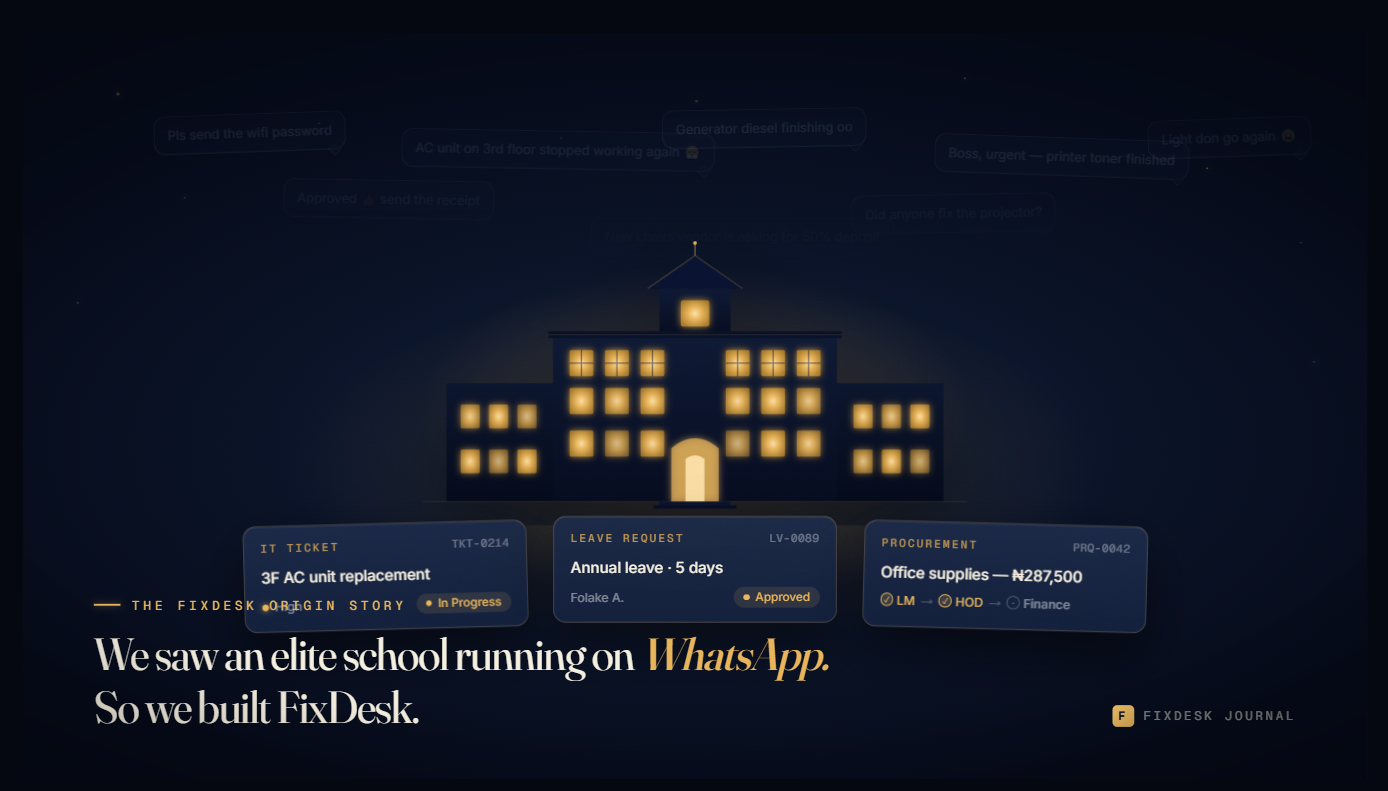
Rugby School Nigeria is not the kind of organization you expect to have an operations problem.
It is one of the most established boarding schools in Lagos — structured, well-staffed, with experienced administrators who take their roles seriously. The people running it are not disorganized. They are not careless. They are, by every visible measure, a well-run institution.
And yet: IT requests were being managed in a WhatsApp group. Facility faults were reported verbally or in a separate chat thread. Leave applications were going to an email inbox that multiple people had access to and nobody fully owned. Procurement approvals were happening through a mix of voice notes, individual messages, and informal conversations that left no paper trail and created constant uncertainty about what had actually been authorized.
The school was not failing. It was operating — successfully — on the operational infrastructure available to it, which was the same infrastructure available to almost every Nigerian organization: group chats, email threads, and verbal agreements.
What it looked like from the inside was something different. It looked like a constant low-grade friction. The IT officer managing a mental queue of who had asked what. The facilities manager getting the same fault report twice because the first one was never formally logged. HR reconstructing a leave approval history from an email chain when a dispute needed resolving. Procurement requests stalling at informal approval stages with no formal record of where they were in the chain.
This is where FixDesk came from.
The Problem With "Good Enough"
There is a particular danger in systems that mostly work. Systems that catastrophically fail get fixed. Systems that create constant small failures get normalized.
The request that gets resolved three days late is frustrating, but not catastrophic. The leave application that gets processed a day after the deadline is a minor annoyance, not a crisis. The procurement approval that happens informally because the formal process is too cumbersome is just how things get done around here.
None of these things, individually, break an organization. Collectively, they establish a ceiling. An organization that cannot reliably track its own internal requests, approvals, and resolutions cannot scale beyond a certain size without its operational complexity becoming ungovernable. The informal systems that work for 30 people fracture under 80.
The ceiling is not visible until you hit it. And by the time you hit it, you are usually already past the point where the pain is invisible.
What we saw at Rugby School Nigeria — and what we have seen consistently across Nigerian organizations since — was a ceiling that could be raised significantly with the right infrastructure. Not new technology. Not a massive digital transformation initiative. Just a proper platform built for how these organizations actually operate.
What We Built, and Why
The obvious answer to "organizations are running on WhatsApp" is to build an IT helpdesk tool. That is the category most people reach for first.
But that is not what Rugby School Nigeria needed. Their IT issue was real, but it was one of five distinct operational workflows all suffering from the same underlying problem: no system of record, no ownership structure, no audit trail.
Building an IT helpdesk would have solved 20% of the problem and left the rest. So we built FixDesk differently.
IT helpdesk for hardware, software, and network issues — because the WhatsApp IT group chat was the most visible symptom.
Facilities management for maintenance faults, infrastructure requests, and campus issues — because a boarding school has a large physical plant that generates constant fault reports that were going nowhere accountable.
Leave management for staff applications, line manager approvals, and HR balance tracking — because leave was the workflow where informal processes most directly affected staff trust.
Procurement for requisitions routed through a defined approval chain — line manager, HOD, finance — because procurement was where informal approvals created the most organizational risk.
Task management for milestone tracking and cross-team assignment — because the project and task work that happened across departments had no structured home.
Five modules. One platform. Every internal request, regardless of type, goes to one place, gets an owner, gets a status, and gets resolved with a record.
This is not a coincidence of product scope. It is a deliberate answer to how African organizations actually operate, where the WhatsApp problem is not an IT problem or an HR problem or a procurement problem — it is an operations infrastructure problem that cuts across every department simultaneously.
What Live Production Looks Like
Rugby School Nigeria is not a pilot or a proof of concept. It is live, in production, with real staff submitting real requests across all five modules.
IT issues flow from submission to assignment to resolution with full status visibility. Facility faults are logged with photos and priority levels, assigned to the facilities team, and tracked to resolution. Staff leave applications move through a defined approval chain — line manager to HR — with timestamps on every action. Procurement requisitions require document attachments at submission, route through a three-level approval chain, and create a complete authorization record before finance processes anything. Task assignments have named owners, deadlines, and status tracking visible to team leads without a meeting.
What changed for the school is not that it is now run by technology. The same people are making the same decisions. What changed is that the decisions leave a record, requests have owners, and the institutional knowledge that makes the school work does not disappear when the person who held it in their head changes roles.
Who We Are Building For
FixDesk is for organizations that are being held back by the operational infrastructure they currently have.
Specifically:
Schools and boarding schools where IT, facilities, leave, procurement, and task management all happen simultaneously across a large physical campus with a significant staff base.
Construction and real estate firms where procurement approval chains, task tracking across project sites, and facilities management directly affect project costs and delivery timelines.
Any organization above ~40 staff that has reached the point where WhatsApp-based coordination is creating visible friction — requests getting lost, approvals stalling, accountability becoming a conversation rather than a record.
We are not trying to be the next Zendesk. We are trying to be the platform that every mid-sized Nigerian organization should already have but does not — built for their approval structures, their organizational hierarchy, and their operational reality.
What We Are Looking For
We are at an early stage. We have production users and a working platform. We are expanding.
If you run an organization that recognizes itself in any part of what is described here — if the WhatsApp group chat, the informal procurement approval, the leave application email thread sounds familiar — we want to talk to you.
If you are an investor who sees what we see: that 39 million Nigerian businesses are running on informal tools and the window to build the right platform for them is now — we want to talk to you too.
FixDesk is not a complicated idea. It is a necessary one. And we built it because the organizations that need it most deserve to have it.
Explore FixDesk in production: Rugby School Nigeria demo · Construction demo · Talk to us
Frequently Asked Questions
Is FixDesk only for schools?
No. Rugby School Nigeria is our first live production customer, but FixDesk is built for any organization managing internal operations across multiple departments — construction firms, real estate companies, manufacturing plants, NGOs, financial services firms, and any mid-sized organization currently running on group chats and spreadsheets.
How is FixDesk different from just using separate tools for each workflow?
The core problem with separate tools is that staff have to know which tool to use for which request. When IT requests go to one platform, leave to another, and procurement to email, the operational overhead of managing five systems becomes as high as the overhead of managing none. FixDesk puts every internal workflow in one place.
Do you work with organizations outside Lagos?
Yes. FixDesk is web-based and accessible anywhere in Nigeria and across Africa. Our current production customers are in Lagos; we are actively expanding.
Can FixDesk handle our specific approval chain structure?
Yes. Procurement approval chains in FixDesk are configurable — you define the levels (line manager, HOD, finance, COO, or any structure that matches your organization) and the system routes accordingly. Leave management approval chains are similarly configurable.